
Christopher Salvito on Making the Chromaplane Electromagnetic Synthesizer

Through the arcane machinations of the Instagram algorithm, I recently became aware of Passepartout Duo, an avant-garde, multi-modal music project consisting of percussionist Christopher Salvito and pianist Nicoletta Favari. I was initially drawn in by their Pieces From Places project, a series of beautifully shot and edited performance videos set in unique locations all around the world.
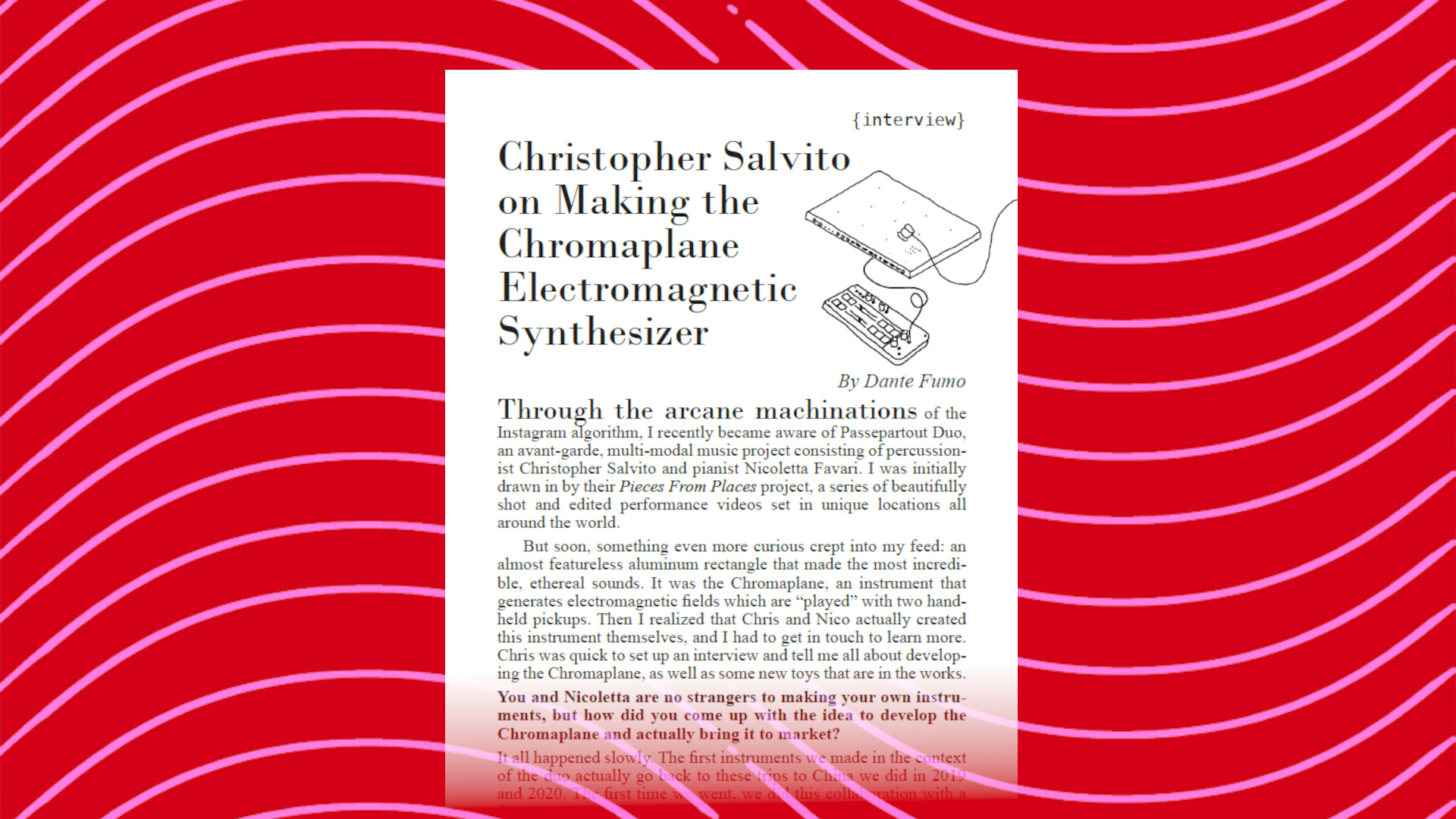
But soon, something even more curious crept into my feed: an almost featureless aluminum rectangle that made the most incredible, ethereal sounds. It was the Chromaplane, an instrument that generates electromagnetic fields which are “played” with two handheld pickups. Then I realized that Chris and Nico actually created this instrument themselves, and I had to get in touch to learn more. Chris was quick to set up an interview and tell me all about developing the Chromaplane, as well as some new toys that are in the works.
You and Nicoletta are no strangers to making your own instruments, but how did you come up with the idea to develop the Chromaplane and actually bring it to market?
It all happened slowly. The first instruments we made in the context of the duo actually go back to these trips to China we did in 2019 and 2020. The first time we went, we did this collaboration with a furniture store in Beijing called Su Yuan, who provided us with these handmade percussion instruments. We made a piece called “Heartwood” using just those instruments, and we were really happy with how it came out.
When we left China, we couldn’t play that piece anymore, so we thought, “We should just make our own version of those instruments.” They were super simple: an amadinda, a little marimba, and stuff like that. We were playing with those for a while, but it was kind of 50% these instruments we made and 50% Ableton. Ableton was doing a lot of the heavy lifting, but we didn’t actually know anything about what was happening behind the scenes. It was just a black box.
So we came back to China with that thought in mind and we decided the next step was to think about electronic instruments. We had a desire to really take control over a hundred percent of the creative process and we got really interested in making analog synthesizers. Because we were in China, the electronic components were so easy to get. There was a seven-floor electronics market just down the street from us in Shanghai, so we just started making analog synthesizers and combining them with textiles for a collaboration we were doing, and it slowly kept growing from there. Once we started creating our own world around these instruments, it felt like anything was possible.
How did those early synthesizer experiments lead to the concept for the Chromaplane?
The Chromaplane kind of came from an installation we did. We were still working with this textile-synthesizer practice, and we had made an installation that was essentially a room-sized instrument using electromagnetic fields. We intended it to be something interactive, but we were also doing performances with it, and we were really surprised with just how expressive this simple thing was. Soon after that, we decided to put it into something that we could take with us and use in more performances.
So, how does it work? Is it sort of like a Theremin, where you’re interacting with an electromagnetic field and turning it into sound?
It shares some DNA with the Theremin, but it works in a different way. Basically, there are these dots on the surface, and each one is the center of an electromagnetic field. There’s ten of them, and they’re each tunable. As soon as you turn the instrument on, it’s producing electromagnetic fields, and they’re each oscillating at different frequencies that you set with these little tuning screws. So it’s always on, making its electromagnetic voice, but you can’t hear it. When you put the pickup near it, the pickup hears the sound of the electromagnetic field, and that’s the instrument.
The Theremin is a little bit different in that it’s producing an oscillation on its own and you are kind of part of the circuit; you’re changing the frequency of it by interacting with an electric field. On a musical level, the main difference is that the Theremin is a monophonic instrument with a continuous range—kind of like a violin—whereas the Chromaplane is more like an organ, where you have discrete notes and it’s polyphonic. I’m a simple person, so I really wanted to make an electronic instrument that’s more like a traditional instrument in that it just does one thing. You just turn it on and it works.
What are all the inputs and outputs on the back for?
You have the inputs for the pickups, and then those pass through two effects stages that help you shape the timbre of the instrument a bit. The first is a resonant low-pass filter, and the next is a delay. The filter is filtering out high frequencies and the delay is adding repetition. There’s also CV inputs that let you control the filter cutoff and delay time, allowing you to connect the instrument with other synthesizers and effects. There’s an envelope follower that outputs CV based on your distance from the surface, and there’s also an external input that allows any external signal to be broadcast as one of the electromagnetic fields on the instrument.
And it’s all analog?
It’s all analog, except the delay is technically digital. It’s a PT2399, which is a chip they use a lot in guitar pedals and stuff like that. It has kind of an analog touch to it, so there’s soft clipping and the sound gets more dampened as it repeats.
You’ve also been prototyping a pretty cool little looping device to go with it. What can you tell me about that?
It’s a vari-speed looper that was kind of inspired by another instrument we made, which was really just a tape looper and delay using cassette tape. There’s this setup called Frippertronics where you have two tape recorders, and the idea is that the repetitions happen within a feedback loop. I wanted to do the same process digitally, but it’s not about emulating the sound of tape, it’s just about taking the process and translating it digitally. When you change the speed, you’re changing the sample rate.
I’m just totally in love with the sound of it. It celebrates the qualities of digital that make it different from analog, so you get all of these realtime undersampling artifacts. I was thinking about how tape is kind of sacred to people—it has this kind of magical aura or something—but when it comes down to it, tape is kind of terrible in its own way and we’re just enjoying all of its unique qualities. So why can’t we just do the same thing with digital?
It looks like it’s designed for performance, with really intuitive hands-on controls.
It’s meant to be super simple, so everything is just right there. One button is double speed and one is half speed, and there’s no limit to how many times you can halve or double the speed. If you just keep doubling it and doubling it and doubling it until the loop is four samples, you can get some extreme aliasing, or you can halve it until it’s just playing rhythmic clicks of different volumes. It’s interesting to hear what happens with the sound when you do that.
And the slider is for finer control of the sample rate?
Yeah, it just changes the speed if you don’t want it to be locked in. With Frippertronics, you’re changing the speed at which the tape is moving, and that’s changing the length of the loop because the distance in time between the two heads gets shorter. This is basically doing the same thing: it’s never changing the length of the loop, it’s just changing the speed.
What’s your process for designing and prototyping these things, and then ultimately turning them into a product that people can buy?
Sometimes it’s long and complicated, and sometimes it’s short and easy. There are factories in Shenzhen that you can send electronic design files to and they will produce a printed circuit board and send it to you. You just send them files that tell them what the circuit board looks like and what components are on it, but whether it works or not depends on your design. You can order something nonsensical and get something back that just totally doesn’t work. So I do all the designing on the computer and I just order this electronic circuit from the factory and hopefully it’s working when we get it.
And then it’s up to you to do all the final assembly, like putting it in a housing and mounting all the controls?
The amount of assembly you need to do really just depends how you design it. They can assemble a lot of it for you; it just depends on what you’re trying to do. It can be very inexpensive, but you also have to think about how many you make. When you’re just making one to five of something, you treat it differently than if you have to make a bunch of them, like with the Chromaplane. If you just make one of something, you can buy one really expensive knob and not care about it. When you make 500 of them, you have to make sure the knob is super cheap and easy to find.
For the looper, we order the circuit board and everything, and then we have to assemble on all the bigger components. We love having wooden enclosures but we are kind of awful woodworkers, so we collaborated with a wood artist called Chih-Hsu Chen Craft and Art, who we met at this artist residency in Taipei. He is awesome, and he made it out of this very good-smelling wood called Hinoki, so it’s a multisensory experience.
How do you scale that process in order to mass-produce something like the Chromaplane?
The Chromaplane is a collaboration with a synthesizer manufacturer in Berlin called KOMA, and we’re so happy with how that turned out. Basically, we just emailed them about what we were making, and they were really enthusiastic about turning it into a product together. We continued developing it for a couple of years, and then, when we felt like it was ready, we organized a Kickstarter campaign and it got funded. We have produced a few different production runs of it, and now it’s generally available. We really hope to do that with some other instruments in the future.
What has the reaction been like?
The first people received it earlier this year, so it’s still kind of new to everybody. I feel like we’re watching people have the experience that we had over the last three years, but from their own perspectives. We lived with the instrument for so long—we probably played like 200 concerts with it—so it’s been interesting to see people undergo the same sort of discovery of the instrument that we had. We made a website for the Chromaplane, and there’s a page where we put up videos of people who’ve made stuff with it. It’s all awesome, and we’re just so happy to wake up in the morning and see some Chromaplane session posted somewhere. It’s really life-affirming.
Do you have plans to make any more instruments and effects?
I’m spending a lot of time working on this other instrument, which is kind of like a Chromaplane cousin. It has a digital sound engine instead of an analog one, and that frees us up to do much more extravagant things with it. It’s just a different way of re-imagining the instrument. So I’ve been spending a lot of time on the firmware for that these days, trying to create an alternate universe for the Chromaplane through that instrument.
The Chromaplane is available now via KOMA Elektronik. Learn more and see what people are making with it at chromaplane.co.